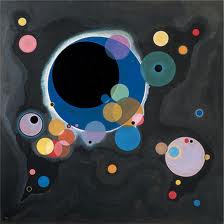
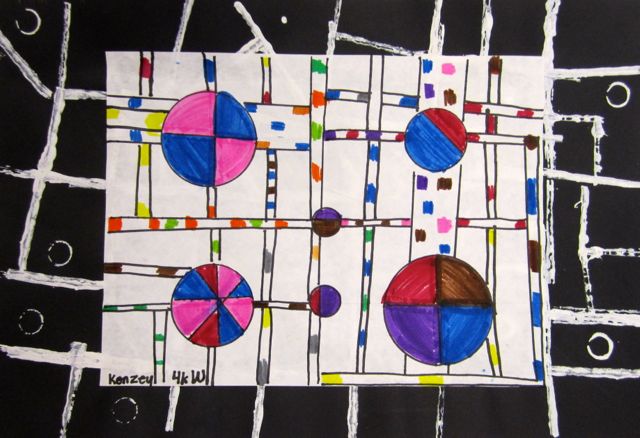
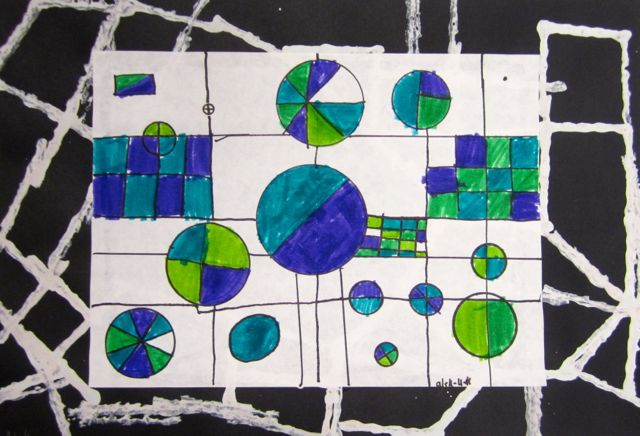
The kids learned that he was an artist with synesthesia. A condition in the brain where color and sound are connected. Kandinsky could hear color as music, and see color when listening to music. He is also considered to be the father of abstract art. We combined the theme of music with an abstract background full of shapes and colors.
First we practiced drawing the instruments on the back of our paper. Then we turned the instruments into a composition of 3-4 instruments with at least one pair overlapping.

After drawing final compositions onto the front of their papers, students did a serious study of the color wheel... complete with pre and post test. In addition to mixing their own colors, students were also asked to connect color mixing with math and fractions!
Here is a sample of the way we approached color mixing with math:

Color mixing is a practical application for fractions. If you don't use the right proportions of each color you just don't get the exact color that you want! For instance, when making green, if you use too much blue (a dark, powerful color) it's very hard to add enough yellow (a light, weak color) to create green. The kids were asked to remember to use two double scoops of the lightest color (4/5) and one tiny dab of the darkest color (1/5). We used these measurements as guidelines. The kids also learned the difference between indigo and violet (indigo is mostly blue while violet is closer to red on the color wheel. When you combine them you get purple).
Each student mixed their own colors on a color wheel worksheet (painters palette):


Students used popsicle sticks (our makeshift serving spoons) to scoop the primary colors out of the paint trays and onto their mixing worksheets. Then they used their brushes to do all the mixing on the sheet. This was the first project that I have used this method for, and I loved being able to have ALL the kids in charge of making ALL of their own colors! Whenever they ran out of a secondary color they had to problem solve to match the original color again! I think this helped the kids learn the color wheel very well.

We started with only primary colors...

Then the kids added their secondary color mixtures. The kids tried not to have shapes of a like color touching. This created even more problems to solve!


This was a project with so many layers of learning and problem solving! It is definitely one I will use in the coming years!
We wrote a simplified version of the learning goals listed below on the back of our art for parents to see what we're learning!
Learning Goals: I can...
- Tell about Kandinsky
- Create and abstract background using regular and irregular shapes
- Create a composition with at least one set of overlapping instruments
- Name the primary and secondary colors
- Use fractions to communicate how to mix primary colors to make secondary colors
- Explain the difference between indigo and violet
- Use good craftsmanship when painting smooth edges and outlines
- Create contrast (as opposed to camouflage) by using different colors in shapes that share a side